Snorkelling in Gran Canaria: What You Actually See
Updated October 1, 2026 · 8 min read
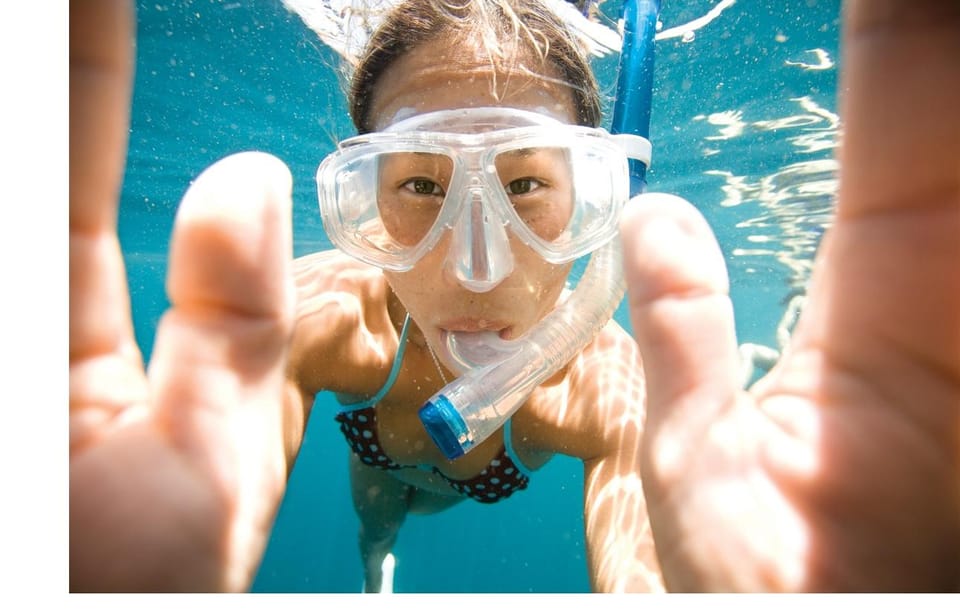
Ask anyone booking a snorkelling trip on Gran Canaria what they want to see, and sea turtles top the list. Not one of the 42 snorkelling and diving tours on GetYourGuide mentions them. What you’ll see instead is plenty: parrotfish, groupers, sea bream, octopuses, rays. The most direct way to them is the Las Canteras Beach Snorkeling Trip in Las Palmas — €39 for two and a half hours, equipment and guide included, 4.5 out of 5 from 442 reviews, and it runs right over the reef described further down in this article. Anyone who wants rays and octopuses explicitly promised needs the Discover Scuba Diving taster dive instead, at €89.
Check availability and prices for the Las Canteras snorkeling trip
Five trips compared
| Trip | Duration | From | Rating | Best for |
|---|---|---|---|---|
| Las Canteras Beach Snorkeling Trip | 2.5 hours | €39 | 4.5 ★ (442) | Beginners and anyone who wants to see the reef off Las Palmas |
| Guided Snorkeling Trip in the South | 2 hours | €45 | 4.0 ★ (120) | Anyone in the south who just wants a quick swim |
| Kayak Cave Tour near Puerto de Mogán with Snorkeling Stop | 3 - 4 hours | €65 | 4.9 ★ (422) | Active couples and families with older children |
| Boat Snorkeling Tour on the West Coast | 3 hours | €69 | 4.5 ★ (65) | Anyone who wants to get further from shore |
| Discover Scuba Diving with Free Transfers | 4 hours | €89 | 4.9 ★ (163) | Anyone who wants rays and octopuses guaranteed |
Go through the 42 snorkelling and diving tours on Gran Canaria — from €28 with a median of €87 — and not one description mentions a turtle. Not the two-hour guided snorkeling trip in the south for €45, not the guided shore round with pickup for €28, not the kayak trips into the sea caves near Mogán. The only description in the whole category naming anything beyond fish is the Discover Scuba Diving taster dive, €89 and four hours — and it promises rays and octopuses, not turtles.
That’s not because the turtles aren’t there. It’s because nobody has pinned down a reliable spot for a sighting, and no operator wants to promise what it can’t guarantee.
What’s actually swimming past your mask
At El Cabrón near Arinaga, an official 2013 survey by the Canary agriculture department lists vieja (a parrotfish), mero (grouper), jurel (amberjack), salmonetes (red mullet), salema (a schooling sea bream), sargos (white bream), abadejo (a local grouper) and bocinegro (red porgy), plus two sea urchins, Diadema antillarum and Arbacia lixula, the seagrass Cymodocea nodosa, and octopuses in the rocks.
Las Canteras beach and its offshore reef, La Barra, run a similar cast: sargos, viejas, pejeverdes (a green-hued wrasse), salemas, and two damselfish, fula blanca and fula negra, one pale, one dark. Bicudas (barracuda), medregales (amberjack), mero and chuchos (stingrays) turn up less often, alongside octopuses, sea urchins and starfish. A diving-industry source, not an official one, puts around 210 algae species here — roughly 30% of everything recorded in Canary waters.
Sardina del Norte, on the north coast, adds animals the other two spots don’t mention: octopuses, spiny lobsters, sea cucumbers, seahorses, scorpionfish and rays. The official tourism portal holaislascanarias.com describes the site as 10 to 20 metres deep, entered down a stone stairway at the pier, with no current — and calls it, in its own words, “ideal for snorkelling.”
Turtles: present, but not pinned to a spot
The Canary Islands government names the loggerhead turtle (Caretta caretta) as the most common sea turtle in local waters, present year-round and more frequent in spring and summer; both the Spanish and Canarian species lists class it as endangered. The green turtle (Chelonia mydas) is rarer and classed as critically endangered. The same source says it’s seen in shallow areas with marine vegetation, “particularly in or around harbours” — on Gran Canaria, occasionally in the marinas of Mogán and Puerto Rico. It hasn’t been recorded in open water.
For El Cabrón, Sardina del Norte or Las Canteras, there is no source claiming regular turtle sightings. That’s the gap this article is built around: the animals are here, but a dependable place to watch them isn’t documented.
A turtle head-start project does exist on the islands, just not here. It runs at Cofete on Fuerteventura, where 186 eggs brought from Cape Verde produced the first hatchlings in November 2006. Gran Canaria’s role is the Taliarte rescue centre near Telde, treating injured animals rather than raising hatchlings.
The other rare visitor: the angel shark
Squatina squatina has been listed as critically endangered on Spain’s species lists for Canary waters since 2019. The archipelago is considered its last real stronghold, and survey areas in the south of Gran Canaria include Anfi del Mar, Mogán, Pasito Blanco and Pata la Vaca — all sites near the kayak and snorkelling trips into the sea caves further along this coast.
What protects these places, and what doesn’t
Gran Canaria has no “Reserva Marina” — the Canary Islands have exactly three, all on Lanzarote/La Graciosa, El Hierro and La Palma. What El Cabrón has, since September 2011, is ZEC status (a Natura 2000 site called Playa del Cabrón, 956 hectares, municipality of Agüimes); the figure “marine reserve since 1999” that circulates online only appears on diving-school pages, not official ones. Las Canteras sits inside the ZEC Bahía del Confital; La Barra, the reef sheltering the beach, lies around 250 metres offshore and runs over two kilometres. Snorkelling and diving are allowed in the designated bathing zones in Las Palmas, at night only with a permit, and collecting any marine animal is banned outright.
The rules for the green turtle are specific: don’t chase, feed or touch it, and report an injured animal via 112. The environment ministry’s good-practice guide for Natura 2000 marine sites is broader but points the same way — don’t feed, touch, chase, stir up the seabed, or take anything home.
Temperature, current and wind
Monthly sea-temperature averages for Las Palmas, from a ten-year commercial dataset rather than an official one, run from a low of 18.9°C in March to a high of 23.4°C in September. Diving centres on the island recommend 5mm neoprene year-round and sometimes 7mm in winter — an industry figure, not an official recommendation.
The trade wind officially blows from the north-east towards the south-west, at a steady 20 km/h, strongest in summer and particularly from June to August, and it picks up speed along the island’s east side. North-facing slopes sit windward, south-facing ones leeward. There is no official source stating that the south or south-west is sheltered from wind, so this article doesn’t claim it. What’s documented site by site: El Cabrón has a current, Sardina del Norte doesn’t.
If you see a Portuguese man o’ war
Physalia physalis appears off these coasts at certain times of year, the Canary government notes, particularly between January and June. Its tentacles can trail up to 50 metres, and even a dead animal washed up on sand still stings. The beach flag system is set out in Canary decree 116/2018: red means no swimming, yellow means caution, green means clear. If you or anyone nearby is stung, that’s a matter for the lifeguard, a pharmacy or a doctor.
What the law actually requires
Spanish regulation RD 550/2020 requires a surface marker buoy flying the “Alfa” flag for diving activities carried out without an accompanying boat, and other vessels must keep 50 metres from the marked zone. There is no equivalent requirement for snorkelling on its own — so if a listing implies otherwise, that’s the operator’s own rule, not a legal one. The general bathing zone reaches 200 metres from the beach, or 50 metres along the rest of the coast.
Matching the trip to the spot
The differences that matter rarely show up in the title. The Las Canteras Beach Snorkeling Trip in Las Palmas, €39 for two and a half hours with 442 reviews, provides equipment and a guiding instructor for exactly the reef described above.
Check dates and prices for the Las Canteras trip
Further from shore, the Boat Snorkeling Tour on the West Coast for €69 and three hours and the Kayak Cave Tour near Puerto de Mogán for €65, 3 to 4 hours and, with 4.9 out of 5 from 422 reviews, the best rating on this list, tied with the taster dive. A second cave kayak tour from Mogán costs the same and runs four hours.
Check availability for the cave kayak tour from Puerto de Mogán
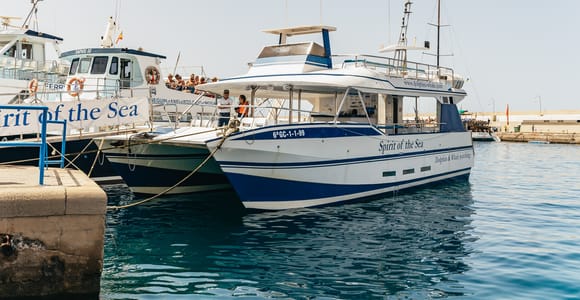
The catamaran with a dolphin stop adds a swim break to a different kind of trip entirely, and anyone who’d rather stay dry and still look underwater has the submarine at Puerto de Mogán as an alternative.
Our recommendation
For most people: the Las Canteras Beach Snorkeling Trip for €39. Two and a half hours, equipment and instructor provided, 4.5 out of 5 from 442 reviews — and it covers the only one of the three areas described here that has its own guided tour. No boat, no seasickness, entry straight from the beach.
Check availability and prices for the Las Canteras trip
Anyone living in the south who doesn’t want to drive to Las Palmas: the two-hour guided snorkeling trip for €45. To be honest: 4.0 out of 5 from 120 reviews is the weakest rating on this list, and two hours is tight once you include the briefing.
For active couples and families with older children: the Kayak Cave Tour near Puerto de Mogán for €65. Three to four hours, the best rating here, tied with the taster dive — but that means paddling before snorkeling.
Anyone who really wants to see rays and octopuses should take the Discover Scuba Diving taster dive for €89: it’s the only tour whose description names both animals. In return, you pay more than double the Las Canteras trip and you’re committed for four hours.
A snorkelling trip isn’t for you if you’re hoping for a turtle. They live in these waters, but none of the 42 tours can promise you’ll meet one — and anyone who does promise that is promising too much.