The South of Gran Canaria: which resort suits whom
Updated October 1, 2026 · 8 min read
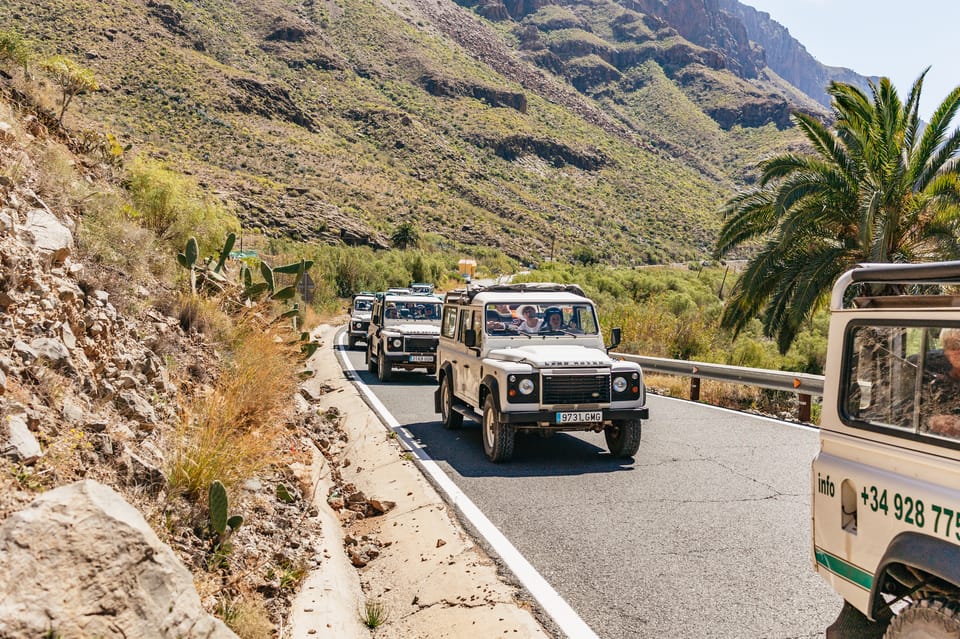
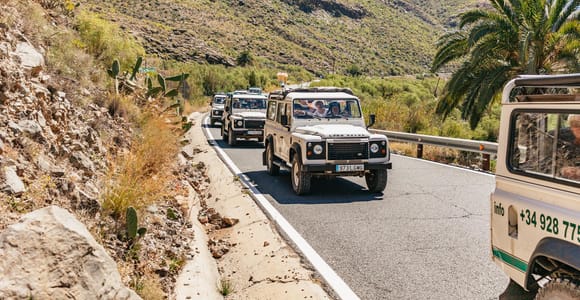
The south of Gran Canaria isn’t one area, it’s a chain of eight resorts along roughly thirty kilometres of coast. In short: Playa del Inglés for everything in one place and for evenings, Maspalomas for the dunes, Meloneras and San Agustín for calm, Arguineguín for everyday life and the market, Anfi del Mar for calm water with small children, Puerto Rico for everything that happens on the water, Puerto de Mogán for the prettiest resort centre in the south. What the south lacks lies in the island’s interior — and that’s where the Off-Road Valleys & Villages Jeep Tour goes, for €69 in five hours, at 4.5 out of 5 from 1,412 reviews.
See dates and prices for the valleys and villages jeep tour
Five excursions compared
| Excursion | Duration | From price | Rating | Best for |
|---|---|---|---|---|
| Off-Road Valleys & Villages Jeep Tour | 5 hours | €69 | 4.5 ★ (1,412) | anyone who wants to see the interior without a hire car |
| Guided Camel Ride in the Maspalomas Sand Dunes | 30 minutes | €18 | 4.5 ★ (5,146) | families with small children and a small budget |
| Submarine Tour in Puerto de Mogán | 40 minutes | €38 | 4.4 ★ (4,309) | non-swimmers and children who’d rather watch |
| Catamaran Dolphin Watch Cruise with Snorkeling | 3 hr 30 min | €38 | 4.4 ★ (5,820) | anyone wanting half a day on the water |
| Jetski Tour from Puerto Rico | 30 minutes | €69.90 | 4.6 ★ (1,153) | couples and teenagers who want speed |
From San Agustín to Puerto de Mogán is roughly thirty kilometres of coast, strung along a motorway, and on it sit eight resorts that look alike from the outside and in practice have almost nothing in common. Anyone booking two weeks here isn’t choosing “the south” — they’re choosing one of these eight.
Just how much of the holiday plays out here shows in the excursion titles: Maspalomas, Playa del Inglés, Puerto Rico, Arguineguín and Puerto de Mogán appear in them noticeably more often than Las Palmas and the resorts of the north.
Why here of all places
The reason is the trade wind. It blows from the north to north-east almost all year, runs into a mountain range of nearly two thousand metres, and drops its moisture in the north. What arrives on the other side is dry and mostly cloudless. That’s why it rarely rains here, why the sea lies calmer than on the north coast, and why the boats depart from here and not there.
The second reason is building history. The resorts of the south grew up from the 1960s onwards on what was then an almost empty coast, planned as a holiday destination rather than having grown organically. That explains the straight streets, the shopping centres, and the fact that there are almost no old town centres here. Anyone looking for historic substance finds it in the north and in the island’s interior, not here.
The eight resorts, from east to west
San Agustín is the oldest and quietest in the row, with dark sand and a clientele that has been coming for a while. Anyone who wants nothing more in the evening than a restaurant is in the right place. There’s also surf tuition right in the resort.
Playa del Inglés is the big one: the longest promenade, the most shops, the most nightlife. In front of the beach sit the jet skis, the banana boat for €25 and the parasailing. This is also where most of the south’s surf schools are, with lessons from €40. The resort isn’t attractive in an architectural sense, and anyone expecting that will be disappointed. It’s practical, though, and for families with older children the sheer density of everything is a real argument in its favour.
Maspalomas means two things: the resort and the dune area. The dunes have been under nature protection since 1987, at the western end stands the lighthouse that’s been in operation since 1890, and between the two lies the Charco, a brackish-water lagoon where birds rest. The guided camel ride at the edge of the dunes costs €18, lasts 30 minutes, and with 5,146 reviews at 4.5 stars is the second most-reviewed experience on the island.
See prices and dates for the camel ride in the dunes
Meloneras adjoins to the west, is newer, pricier and quieter, with a seafront promenade that runs all the way to the lighthouse. Anyone staying here goes for an evening stroll rather than a night out.
Arguineguín is the only resort in the row that existed before — a fishing village that has kept an everyday life of its own. The market is a destination in its own right; a round trip to the flea market and the harbour at Mogán costs €55.
Anfi del Mar is a small, artificially created bay with pale sand and very calm water. Parasailing for €50 takes place in front of the beach, along with flyboarding and guided buggy tours setting off from the beach.
Puerto Rico is the engine of the whole south. Almost everything that happens on the water departs from here: dolphin and whale watching from €30, catamaran trips from €30 — including the trip with dolphin watching and snorkelling for €38, with 5,820 reviews the most-reviewed excursion on the island — and the jet ski tour for €69.90. The resort itself is built narrow and steep; anyone who’s only here for the boats won’t mind.
See availability and prices for the catamaran dolphin trip
Puerto de Mogán sits at the western end and is the prettiest resort in the south — low white houses, canals with small bridges, a fishing harbour next to the marina. The brochures call it “Little Venice”, and for once the comparison is roughly true. This is where the submarine trip for €38 departs, the fourth most-reviewed excursion on the island with 4,309 reviews, along with kayak tours to the coast’s sea caves for €65. A guided visit to the resort’s market is on offer for €22.
The beaches aren’t the same beach
“Beach in the south” sounds like one thing and is at least four. Playa del Inglés and Maspalomas are joined together and form several kilometres of open sand, with the dunes at their back. It’s the widest beach on the island and also the windiest of the four: there’s nothing there to stop the trade wind.
San Agustín has darker, coarser sand and considerably less bustle. Anyone looking for calm and willing to forgo the bright postcard image is better off here.
Playa de Amadores near Puerto Rico and the bay at Anfi del Mar are both artificially created: pale sand, protected by breakwaters, hardly any waves. That’s exactly why they’re the easier addresses with small children — and exactly why they’re crowded.
Puerto de Mogán has only a small beach next to the harbour. Anyone staying there is staying for the resort, not for the sand.
What they all have in common: none of them offers natural shade. Renting or bringing a parasol here isn’t a question of comfort.
The distances that matter
From San Agustín to Puerto de Mogán via the motorway takes around half an hour. That sounds like nothing, and it’s exactly why you should still choose your base carefully: anyone staying in San Agustín and departing from Puerto Rico three times a week spends an hour in the car or on the bus each time.
To Las Palmas from the south it’s a good fifty kilometres and just under an hour. Into the mountains it takes barely less time, but it feels longer: the roads up to Fataga, Tejeda and the Roque Nublo are narrow and winding. That’s why the day trips into the island’s interior from the south last 7 to 9 hours and cost €37.60 to €79.
What the south doesn’t have
It has no old town centre, no museum of note, and no green landscape. The four things Gran Canaria is known for beyond the region — the old town of Las Palmas, the mountain villages, the ravines and the green north — all lie elsewhere. Anyone spending two weeks here who wants to have seen the island should plan two to three days for getting away.
It does have a water park, though: Aqualand lies on the road to Palmitos Park, a few kilometres inland from Maspalomas. Then there are the parks near Maspalomas and in Agüimes — which of them suits which age is covered in Gran Canaria with Kids.
Wind, sun and the best time of day
The wind picks up over the course of the morning and drives sand across the beaches in the afternoon. For boat trips that means the early departure sails flatter. For the beach it means the morning is the better part of the day with small children.
A few times a year the calima arrives, Saharan dust in the air. Then it’s hazy and oppressively hot, visibility often reaches only a few kilometres, and the best plan is to stay indoors. On the beaches there’s shade only where you rent it, and none at all in the dunes.
The sea runs between about 19 degrees in late winter and 23 degrees in early autumn. It’s the Atlantic: the first few minutes are cooler than the pictures suggest.
Which resort for whom
With a baby, what counts is that supermarket, pharmacy and beach are within walking distance and the path is paved — for that, Meloneras, San Agustín and Puerto de Mogán are the calmer addresses; the details are in Gran Canaria with a Baby.
With a toddler, the length of the journeys decides. Playa del Inglés and Maspalomas have everything next to each other, and two of the short experiences — camel ride and submarine — lie within half an hour; the banana plantation in Arucas is an hour’s drive north. More on this in Gran Canaria with a Toddler.
Anyone who wants to be on the water above all should stay in Puerto Rico or Puerto de Mogán and save themselves the journey every day. Which trip takes how long and what you should ask beforehand is covered in Boat Trip with Kids: What’s the Minimum Age?.
And anyone with plans for the evening can’t get around Playa del Inglés. That’s not a verdict on the resort — it’s a fact about the other seven.
Our recommendation
For most people who already know the south: the Off-Road Valleys & Villages Jeep Tour for €69 and five hours. It’s the shortest route from the coastal strip into the interior the south itself doesn’t offer, and with 1,412 reviews at 4.5 out of 5 it’s broadly judged. Five hours leaves the afternoon free for the beach.
For families with small children and a small budget: the guided camel ride in the Maspalomas sand dunes for €18. Thirty minutes is short enough, and the journey there from Playa del Inglés or Meloneras isn’t a day trip. The submarine tour in Puerto de Mogán for €38 is the option for non-swimmers.
For half a day on the water: the catamaran dolphin watch cruise with snorkelling for €38 and three and a half hours — with 5,820 reviews the most-reviewed excursion on the island. Dolphins are wild; nobody can guarantee a sighting.
The south is not for you if you expect an old town centre, museums or green landscape. Those lie in the north and the interior, and for that you need two to three days away — or a hire car for exactly those days.