Wild animals on Gran Canaria: what's genuinely wild, and what's a show
Updated September 16, 2026 · 7 min read

Gran Canaria sells a shortlist of animal encounters: a boat trip that might cross paths with a dolphin, a park with parrots and sharks behind glass, a camel crossing the dunes at Maspalomas. Only one of these involves an animal that owes you nothing and might simply not appear; the rest are staffed, fenced or bred for exactly this purpose. That does not make them worthless — it means “wildlife encounter” is doing different work each time. This article sorts out which is which, and spends the most time on the rules that actually govern whale and dolphin watching here, because almost nobody reading a booking page has seen them.
Dolphins and pilot whales that never left
Spanish waters hold twenty-seven whale species, per the preamble of Royal Decree 1727/2007, over half of them threatened. Off Gran Canaria’s south and southwest coast lies a marine Natura 2000 site, Franja marina de Mogán, 29,993 hectares, designated in 2011, protecting the bottlenose dolphin, the loggerhead turtle and the green turtle.
Researchers from an NGO and a university — not a government agency, worth flagging as such — have found bottlenose dolphins and short-finned pilot whales living here year-round, with individual animals photo-identified over ten and eighteen years respectively. These are not passing pods glimpsed once a season; they are neighbours.
Nobody can promise you a sighting
We looked for an official or scientific sighting rate for Gran Canaria’s boat trips and found none. The 97% figure circulating online traces back to one operator’s own marketing, not an independent count — treat it as advertising, not data.
A trip can go out, search for two hours and come back having seen nothing, and no operator — however well run — may promise otherwise. If a listing offers a free repeat trip after no sighting, ask what triggers it and whether it applies to your date.
The rules almost no visitor has read
Royal Decree 1727/2007 draws an invisible zone around every whale or dolphin: 500 metres of radius, 500 metres of airspace, 60 metres of depth. Inside it, five bands apply. An exclusion zone, at least 60 metres out, is off limits entirely. A restricted zone, 60 to 300 metres, allows at most two boats at once, and none at all if isolated young animals or a mother with a calf are present. An approach zone, 300 to 500 metres, permits at most two boats waiting, coordinated by radio. Above and below, aircraft and divers may not linger.
Boats must keep to 4 knots or less, and engines and propellers must stay off while animals are within 60 metres. Sonar and echo sounders must be switched off. Touching, feeding, throwing waste overboard, and cutting through or splitting a group are all forbidden, as is swimming or diving inside the exclusion zone. The decree sets no maximum duration for a watching session.
A regional rule, Decree 178/2000, adds detail: harassment includes swimming or diving within 500 metres of the animals — ruling out swimming with wild whales or dolphins here in practice — staying within 100 metres for more than 30 minutes, approaching within 100 metres when two boats are already present, or within 500 metres when three already are. Approaching head-on, from behind, or at under 30 degrees to the animals’ path is banned, as is jet-ski observation closer than 500 metres. The Agencia de Protección del Medio Urbano y Natural handles enforcement; we found no published fine amounts, so none are quoted here.
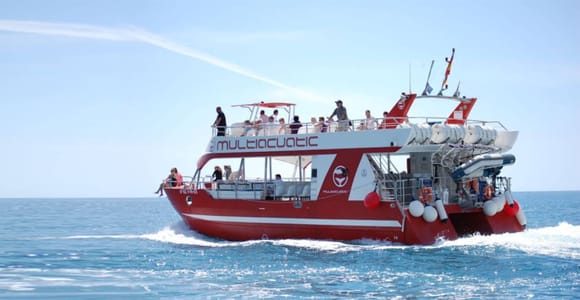
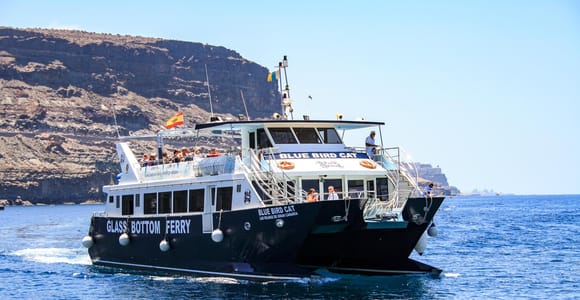
If you want to see what a compliant trip looks like before booking, check current whale and dolphin watching departures. Our Líneas Salmón dolphin trip guide and our comparison of short and long dolphin trips for children both cover boats operating in these waters.
The flag to look for before you step aboard
Article 15 of Decree 178/2000 requires licensed excursion boats to fly a “Barco Azul” marker: canary yellow, 80 by 50 centimetres, blue capital letters, a red-and-white lifebuoy, two white pilot whales on a blue field, and its printed validity period. The Canary tourism authority issues and renews it yearly. A boat missing the flag, the permit or its required guide is breaking the rules, whatever else it advertises — look for it at the quay before you hand over a ticket.
Animals that need no boat ticket
Gallotia stehlini, a giant lizard found only on Gran Canaria, appears on both the Spanish and Canary protected-species lists. The Gran Canaria blue chaffinch survives mainly in the pine forests of Inagua, Ojeda and Pajonales; the regional government puts the population near 250 birds, with a dedicated recovery plan. The island’s great spotted woodpecker is its own subspecies, found nowhere else, and the island canary and Berthelot’s pipit are Macaronesian endemics — a secondary source, flagged as such.
Five areas are protected specifically for birds: Tamadaba; Ojeda, Inagua y Pajonales; Macizo de Tauro; Ayagaures y Pilancones; and Juncalillo del Sur. The Charca de Maspalomas, inside the dunes nature reserve, has an observation platform, though we found no official Cabildo monitoring programme. One fact worth carrying with you: the Canary Islands have no native amphibians — the two frog species present were introduced.
The camel is not wildlife
Dromedaries arrived from the African coast in the early fifteenth century, during the European conquest, and worked as farm animals until the 1960s, when tourism took over as their job. Since 2011 the “Camello Canario” has been listed in Spain’s official livestock breed catalogue as a native breed at risk of extinction. One documented welfare rule covers transport: a circular from the Dirección General de Ganadería, published in the Boletín Oficial de Canarias on 14 June 2016, requires animals to be loaded on their own legs, never craned, with a minimum of 1.75 metres of space per animal. We found no heat, working-hour, load or inspection figures for camel operations on the island, and none are claimed here. Our camel ride in the Maspalomas dunes guide covers what the excursion itself involves.
Parks, and a law that protects animals already there
Palmitos Park and the Aquarium Poema del Mar both belong to AIZA, the Iberian zoo and aquarium association. Poema del Mar, in Las Palmas, opened on 17 December 2017 and belongs to the Loro Parque group; our Poema del Mar aquarium guide has the detail. Agüimes’s Cocodrilo Park is not on the AIZA list and describes itself as a rescue centre for exotic animals, some seized by the SEPRONA environmental police. We could not confirm EAZA membership or a specific rewilding project for any of these parks.
Spain’s animal welfare law, Ley 7/2023, restricts new breeding and keeping of whales and dolphins in captivity to research and conservation. A transitional clause allows animals already held elsewhere when the law took effect to remain there until they die and keep appearing in shows. In plain terms: no ban on dolphinariums or shows, only a freeze on new ones — a statement of what the law does, not a verdict on it.
If something looks wrong
Feeding whales or dolphins, or throwing anything overboard near them, is against the rules on any excursion. Spanish nature conservation law bans killing, capturing, pursuing or disturbing protected species and destroying their nests or resting sites; via the Canary catalogue, that protection covers the giant lizard and the island’s birds too. If you find a stranded whale or turtle, call 112 and do not touch it. We found no general rule against feeding land birds or lizards, so none is claimed here — use the judgement you would anywhere else. Our things to do on Gran Canaria guide sits alongside our whale and dolphin watching listings and our catamaran trip pairing dolphin watching with snorkelling.