What to see on Gran Canaria: what’s worth it and what costs time
Updated September 6, 2026 · 7 min read

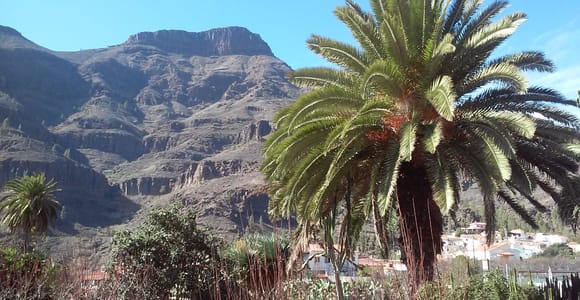
“A continent in miniature” is a marketing line you hear on every second island. On Gran Canaria it happens to be true, and there’s a number to prove it: the island is around fifty kilometres wide, and at its centre stands a mountain range of nearly 1,950 metres. A peak of that height on such a small landmass catches the trade wind clouds before they reach the south. Almost everything else follows from that — a green, often cloudy north, a dry, almost always sunny south, and in between a mountain world that has nothing in common with either.
For visitors, that means the island can’t be seen in passing. Anyone staying in the south who wants to see the mountains, Las Palmas and the north-west needs to set aside three days for it. That’s not bad news, just a planning fact.
The centre: the real reason to come here
Roque Nublo is the island’s landmark — a rock roughly eighty metres tall that stands free on the mountain ridge at 1,813 metres, the remnant of a solidified pyroclastic flow around which everything else has eroded away. The path up from the car park is short and not difficult, but stony and without shade.
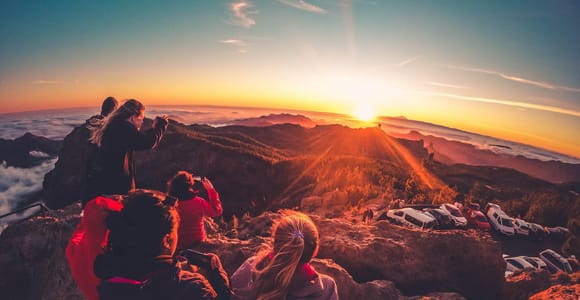
Pico de las Nieves, at nearly 1,950 metres, is the highest accessible point. On clear days, the Teide on Tenerife stands on the horizon, a good hundred kilometres away and yet within reach. On hazy days you can see your own hand and nothing else — that’s part of the truth about this viewpoint.
In between lie the mountain villages: Tejeda in a basin, Artenara, the island’s highest settlement, Fataga on the road up from the south. And the Barranco de Guayadeque, a ravine with cave dwellings, some of which are still inhabited today — complete with a church and restaurants cut into the rock. Since 2019, the cultural landscape around Risco Caído in this area has been a UNESCO World Heritage Site; the west of the island has been a biosphere reserve since 2005.
The day trips into the interior are correspondingly long: 7.5 to 8.5 hours for 46 to 48 €, the guided summit hike 70 € for 9 hours — it’s one of the island’s best-rated tours, with 4.9 stars from 364 reviews. Anyone driving themselves should know that the roads are narrow, winding and in places without a guardrail. This is the wrong outing with small children; why, is explained in Gran Canaria with a toddler.
Las Palmas: the only real city
Las Palmas was founded in 1478, the year the Castilian conquest of the island began. The historic core, Vegueta, is a quarter of cobbled streets, courtyards and wooden balconies, with the Santa Ana cathedral and the Casa de Colón — Columbus stopped here in 1492 on his way west. A guided walk through Vegueta costs 27 € and lasts an hour and a half.
At the other end of the city lies Playa de Las Canteras, a city beach roughly three kilometres long, protected from the Atlantic swell by an offshore reef — La Barra. Behind it the water is calm; in front of it, people surf. A snorkelling trip at Las Canteras costs 39 €.
And the Poema del Mar aquarium, with 4,464 reviews at 4.8 stars, shares the island’s best rating for a major attraction with Palmitos Park, skip-the-line ticket 29 €. The hop-on hop-off bus tour through the city costs 25 € and comes in at 3.7 stars from 1,002 reviews — the weakest score among all the widely booked tours here. That’s a hint, not a verdict, but it’s there in the numbers.
The green north and the north-west
Beyond the mountains the island becomes a different place. Teror, with the Nuestra Señora del Pino basilica, is the island’s pilgrimage site and has a market known well beyond the island; a guided market trip to Teror and San Mateo costs 33 € and takes 6 hours. Arucas and Firgas lie on the same route — a round trip from the south is available for 52 €.
The real special case is the Agaete valley in the north-west: one of the very few coffee-growing areas in Europe. A guided tour with tasting at a finca there costs 16 €. The ferry to Tenerife also departs from Agaete, 80 minutes for 55 €.
The water: the south has the boats
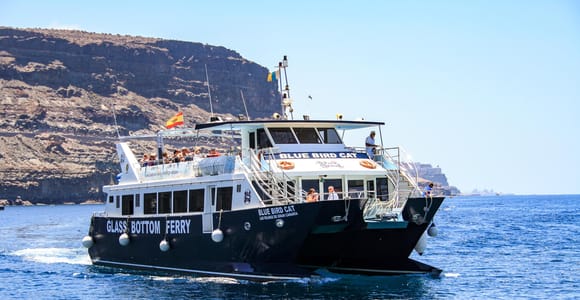
Almost everything that happens on the water starts on the south-west coast — between Puerto Rico, Arguineguín and Puerto de Mogán lies the island’s lee side. Whale and dolphin watching is available there year-round from 30 €, catamaran trips with a swim stop from 38 €, the submarine in Puerto de Mogán for 38 €. To be honest about it: dolphins are wild, and no trip guarantees a sighting.
Which of the eight towns in the south suits whom, where each boat departs from and what the short distances there are worth is explained in detail in The south of Gran Canaria. The Maspalomas dunes — protected since 1987, with the lighthouse from 1890 at the western end — are the island’s most famous landscape and are also located there.
What this island doesn’t have
It has no sea caves in the style of Portugal’s Algarve and no single place where everything comes together. Anyone staying in the south gets sun and boats, but neither old town nor greenery. Anyone staying in Las Palmas gets city and beach, but more clouds and an hour’s journey to where the boats depart.
And the famous mountain road is exactly the problem for some people: hours of hairpin bends. Anyone prone to that should plan the mountain day not as a bus tour, but with their own car and breaks.
Clouds, dust and visibility
The view isn’t a given on this island — it’s a matter of luck, though the odds can be improved. The trade wind clouds bank up against the mountains’ northern flank and mostly pass through below the highest points. That’s exactly what produces the image people drive up here for: standing in the sun at the top, looking down on an unbroken white blanket with the Teide rising out of it in the distance. The same cloud cover, though, means grey skies over Las Palmas on many days.
Its counterpart is the calima, Saharan dust in the air. It arrives a few times a year, makes the air hazy and oppressively hot, and kills any long-distance view. Anyone who drives up on such a day sees the rock in front of them and nothing else. It usually clears after a day or two of strong northerly wind.
Driving yourself or going guided
Both work, and the decision isn’t really about price. A guided mountain tour costs 46 to 48 € and takes the driving off your hands; in return, you stand where the bus stops, and for as long as the schedule allows. Driving yourself gives you more flexibility, but you’ll need to reckon with tight bends over long stretches.
One point that’s often overlooked with guided tours: ask how long the hotel pick-up round takes. It’s included in the stated total duration, and it can be the difference between a pleasant day and a very long one.
How to put it together
The airport lies on the east coast, roughly halfway between Las Palmas and the south; the GC-1 motorway connects the two in just under an hour. From the range of 247 tours — from 10 €, averaging 69 € — a week can be put together well if you stick to one simple rule: at most one long day every three days.
For families that goes double. What works at which age is covered in Gran Canaria with kids, for the youngest ones in Gran Canaria with a baby, and what needs to be clarified about the water before booking in Boat trip with kids: what’s the minimum age?.
If you take away just one thing: go up on a clear day. The coast exists elsewhere too; the view from Roque Nublo over a sea of clouds with the Teide rising out of it does not.